Why: the urgent need to rethink stowage planning
Container shipping has evolved rapidly. Ships are larger, voyages are more complex, and regulatory oversight is tighter than ever. Stowage planning, once a manual and manageable task, is now an overwhelming challenge. Shipping lines today face:
- Vessel scale explosion: ULCCs (Ultra-Large Container Carriers) carry over 24,000 TEUs.
- Multi-port loading pressure: planning for multiple load and discharge ports, each with unique constraints.
- Regulatory minefields: IMDG Code, SOLAS, lashing strength, trim, GM, and class limits all must be checked.
- Time-critical disruptions: last-minute booking changes and updated PRE EDI files are frequent and risky.
- Human limitations: even the most skilled planners take hours to plan, often settling for suboptimal stowage.
What: introducing SONATA
These realities mean that traditional tools, spreadsheets or manual planning software, are no longer enough. Manual methods increase the risk of re-stows, port delays, crane imbalance, DG compliance violations, and lost efficiency. The cost of inefficiency is now too high to ignore.
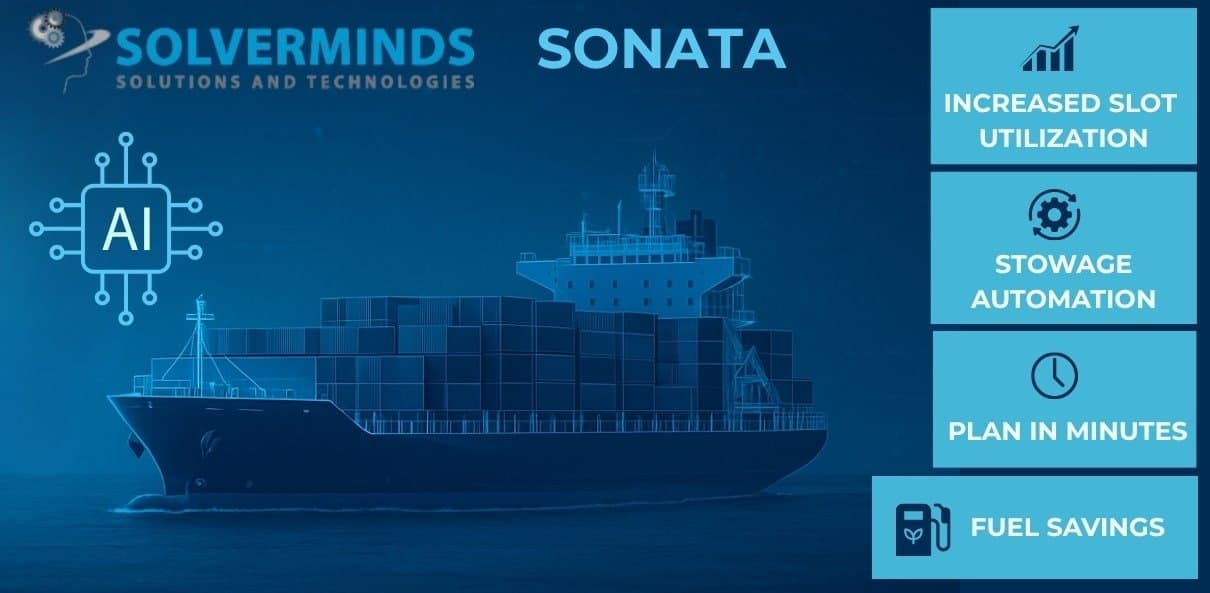
SONATA is an intelligent, AI-powered, end-to-end stowage planning application developed by Solverminds. Designed specifically for modern liner operations, SONATA is not just assistive. It is fully automated and field-proven. It answers today's planning challenges with:
- AI-based slot optimization that evaluates thousands of container permutations and constraints.
- Regulation-aware logic that bakes in IMDG rules, VGM, class limits, and DG segregation.
- Real-time replanning that instantly adapts to operational changes or booking updates.
- Crane split optimization that reduces berth times.
- DG auto-placement that replaces hours of manual validation with smart clustering in minutes.
- Seamless data integration with BAPLIE, MOVINS, Excel, and custom formats.
How: a live operational case
SONATA is not theoretical. It has been tested, deployed, and scaled by major global shipping lines. One example: a 20,000 TEU vessel was scheduled to arrive at port with a load list of approximately 9,500 TEUs, received seven hours before arrival. The cargo mix was highly complex: 200+ dangerous goods containers, 150+ reefers, 30+ out-of-gauge units, and multi-POD cargo with intricate segregation requirements.
This last-minute, high-volume scenario would normally require 4-5 hours or more of manual planning, with high chances of errors or rule violations. Using SONATA, the entire stowage plan was generated in 9 minutes 50 seconds, while ensuring:
“The automated plan was ready for execution without manual corrections: no re-stows, no planning stress, and a safe, efficient, on-time sailing.”
- Full compliance with the IMDG Code, vessel Document of Compliance, stability (GM, trim), lashing forces, and visibility constraints.
- Optimized crane splits, reducing expected berth time during load and discharge.
- Slot utilization of roughly 99%, maximizing vessel space.
- Improved trim and weight distribution, contributing to fuel savings for the voyage.
Key differentiators
Unlike tools that offer semi-automation or require manual intervention, SONATA provides end-to-end planning from raw input to ready-for-execution output. Compliance checks are not an afterthought; they are built into the planning logic. The system is live and proven, not stuck in pilot or research mode, and it is already deployed across 250+ vessels by top-tier carriers globally.
The broader impact: fuel, ESG, and planner empowerment
SONATA does more than optimize planning. Improved vessel trim means less drag, lower fuel burn, and reduced CO2 emissions. Higher utilization means more containers per voyage and lower emissions per TEU. Fewer re-stows and re-handlings mean less port idling and cleaner operations. Automated compliance means safer voyages and reduced liability.
It also transforms the planner's role: from rule-checking and firefighting to high-level supervision and decision-making. SONATA delivers speed, precision, and compliance in a user-friendly system that is proven in live voyages, not just demos.