Is Traditional Scheduling Still Enough?
As tug operations become more dynamic, is traditional scheduling still enough? That question is starting to surface in planning offices and boardrooms alike.
For decades, tug scheduling has been treated as an operational detail, something a dispatcher handles with a whiteboard, a radio, and years of harbour experience. But the variables involved in a single day's scheduling decisions have multiplied, and the commercial consequences of getting them wrong have grown along with them.
A Shift Already Underway
Picture a typical shift. At the start, the schedule looks workable. Every tug has a job, every vessel has coverage, and the plan seems to hold together.
Then a vessel arrives late. Another booking comes in from a customer who needs a tug within the hour. One tug is repositioning across the harbour toward its next assignment. Another is approaching its crew rest period. A high-priority job requires a specific level of bollard pull, and the tug best suited for it is already committed elsewhere.
None of these events is unusual on its own. Together, they force a dispatcher to re-evaluate the entire schedule, often several times within a single shift.
The Real Cost Isn't Always Visible
When people think about tug scheduling costs, they tend to picture the tug that's working. But the more expensive tug is often the one that isn't.
It's the tug repositioning across the harbour when it didn't need to. The tug sitting idle in the wrong place while a job goes to a competitor or a spot-in resource. The tug assigned to a job it could technically handle, but at a fuel and capacity cost that shows up later when a bigger job arrives and the right tug isn't available.
These costs compound. A single scheduling decision early in a shift can quietly narrow the options available two or three jobs later, and the operator often has no easy way to trace that connection back to its source.
“The more expensive tug is often the one that isn't.”
Why Conventional Scheduling Struggles to Keep Up
Experienced dispatchers carry deep operational knowledge. They know their harbour, their customers, and their fleet. The challenge isn't a lack of expertise. It's the sheer number of interconnected variables a person is being asked to weigh at once, in real time, often under time pressure.
Manual scheduling also struggles to explain itself. When a tug is selected for a job, or passed over for one, the reasoning often lives in the dispatcher's head rather than in a record the rest of the organization can see. That makes it harder to learn from patterns, harder to plan capacity, and harder to justify decisions when customers or management ask why.
Booking information adds another layer of friction. Job requests still arrive by phone, email, and messaging apps in inconsistent formats, and someone has to translate that into a usable schedule entry before planning can even begin.
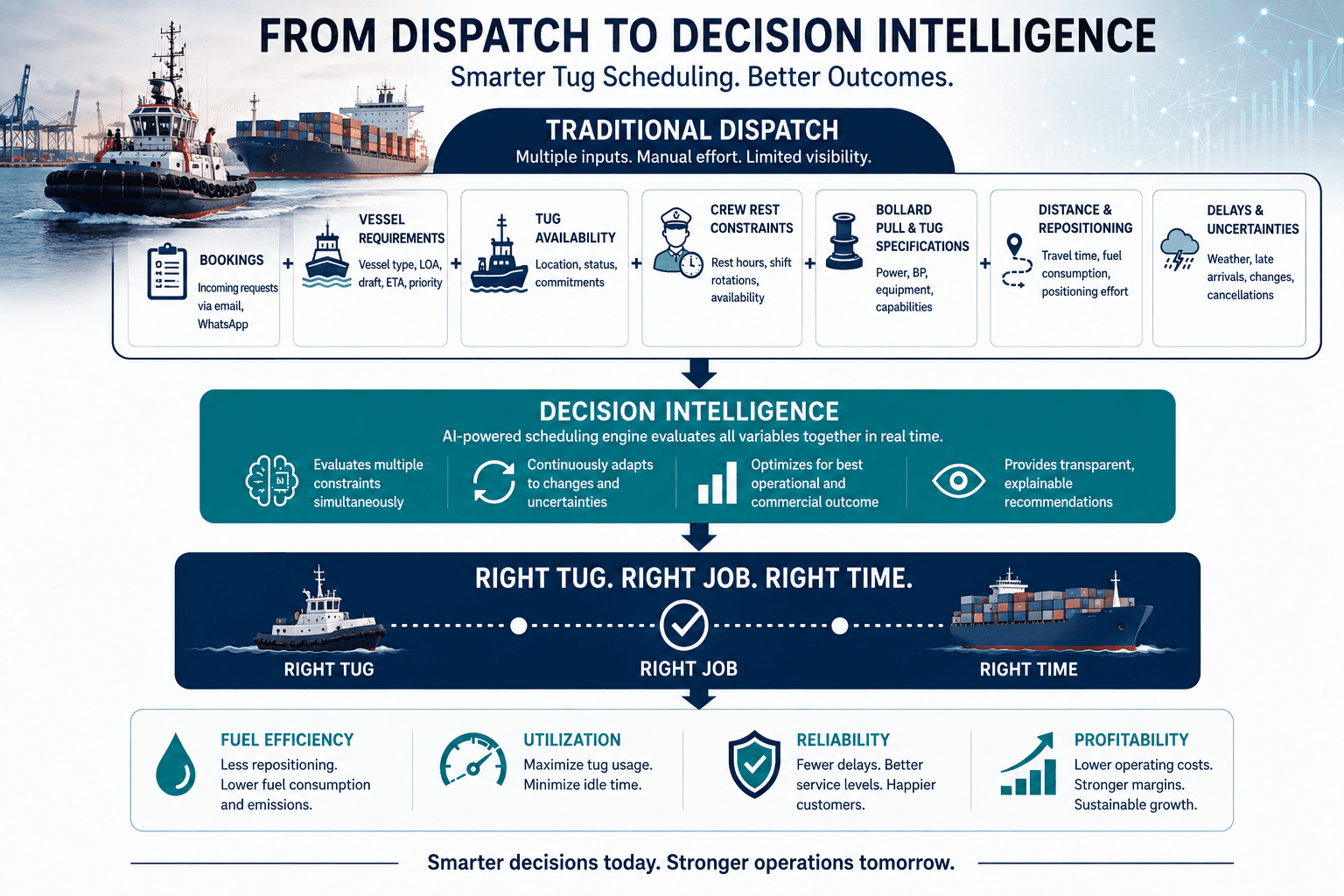
The core difficulty is the number of variables in play at once, each interacting with the others. A decision that looks reasonable for one job can quietly create a constraint for the next:
- Vessel requirements and bollard pull
- Tug availability and repositioning distance
- Fuel consumption and crew rest limits
- Delays, job priorities, and idle time
- Last-minute booking changes
Scheduling as a Commercial Capability
The tug owners and operators asking the sharpest questions today are not asking whether AI can build a schedule. They're asking how much operational and commercial value is sitting unused in the way scheduling decisions are currently made.
That reframes scheduling. It stops being a back-office task and becomes a lever for utilization, cost control, service reliability, and competitive positioning. This is the space Smart-Tug, Solverminds' AI-powered tug scheduling and optimization platform, is built for.
Right Tug. Right Job. Right Time.
Smart-Tug's positioning is deliberately simple, because the problem it addresses is not. The platform evaluates operational constraints together, rather than one at a time, to generate practical tug assignments while keeping the operator firmly in control.
Current Smart-Tug capabilities, drawn from its scheduling engine, include:
- AI-driven tug scheduling that weighs multiple constraints simultaneously rather than sequentially
- Tug-job matching based on vessel requirements, bollard pull, and operational priorities
- Dynamic repositioning to reduce unnecessary movement across the harbour
- Fuel-aware scheduling, with crew rest consideration built directly into the logic
- Delay management, so late arrivals and last-minute changes are absorbed without rebuilding the plan from scratch
- Continuous re-optimization as conditions shift during a shift
- A visual, Gantt-based interface, backed by KPI and analytics visibility into how the fleet is used over time
Making the Reasoning Visible
One of the more persistent concerns about AI in operational settings is the black box problem: a system producing recommendations that nobody can explain.
Smart-Tug is built around the opposite idea. Operators need to understand why a tug was assigned, or why it wasn't, not just accept the outcome.
Consider a common scenario. A higher bollard-pull tug may technically be free for a job. Assigning it there might work, but it could also burn more fuel than necessary or leave insufficient capacity available for a demanding job that's expected an hour later. Smart-Tug's explainability capability surfaces that trade-off so the operator can see the reasoning behind the recommendation, agree with it, or override it.
“Operators are far more likely to rely on a system they can question and understand than one that simply hands them an answer.”
The Commercial Case
Smarter scheduling creates the potential for gains across several fronts, though the scale of any benefit depends on each operator's own fleet, harbour layout, and booking patterns. These are directional outcomes, not guarantees. What Smart-Tug provides is the visibility and evaluation capability to pursue them consistently, rather than opportunistically. Areas where operators can work toward improvement include:
- Better utilization of tugs already in the fleet
- Reduced unnecessary repositioning and lower fuel consumption per job
- Fewer operational delays
- More deliberate allocation of tug capacity against job priority
- Reduced reliance on spot-in resources where avoidable
- Clearer visibility into fleet availability across a shift
Sustainability Follows Naturally From Better Scheduling
Sustainability in towage is increasingly connected to operational efficiency. The IMO's 2023 GHG Strategy calls for the carbon intensity of international shipping, measured as CO2 emissions per transport work, to fall by at least 40% by 2030 compared with 2008. The Strategy also recognizes the role of operational efficiency and cooperation across the maritime value chain, including ports, in supporting shipping's broader decarbonization pathway.
For tug owners and operators, this reinforces the commercial value of reducing unnecessary movements and fuel consumption. Smarter tug assignment, more appropriate repositioning speeds, and better fleet utilization can support both operating-cost and emissions objectives. Smart-Tug provides visibility into fuel and CO2 performance at the tug and job level, helping operators bring sustainability considerations into everyday scheduling decisions.
Booking Automation: An Enabler, Not the Headline
Scheduling intelligence is only as good as the information feeding it. If bookings arrive as scattered emails and messaging-app notes that someone has to manually re-key, the best optimization engine in the world is working with a lag.
This is where ASTRA fits in. It captures booking information from email and messaging apps and converts it into structured scheduling inputs, reducing repetitive manual entry and letting new bookings enter the planning workflow faster. It's a supporting capability that keeps the scheduling engine fed with accurate, timely data. It is not the main proposition, but without it, everything downstream moves more slowly than it should.
A Co-Pilot, Not a Replacement
None of this is about removing the dispatcher from the loop. Smart-Tug is built to give the dispatcher a stronger decision-making engine, not to replace their judgment.
Operators using the platform remain able to review the schedule, understand the reasoning behind each recommendation, make adjustments, and rerun the optimization whenever circumstances change. The goal is a system that acts as a co-pilot for maritime operations, handling the volume of interconnected variables so the human operator can focus on the calls that genuinely require experience and context.
“Smart-Tug is built to give the dispatcher a stronger decision-making engine, not to replace their judgment.”
The Question Worth Asking
The stronger question for tug owners and operators isn't whether AI can produce a tug schedule. It's how much operational and commercial value is currently being left on the water because today's scheduling decisions cannot evaluate the full picture at once.
As towage operations face growing pressure around cost, utilization, service reliability, and sustainability, intelligent scheduling is moving from a nice-to-have into a competitive capability. Smart-Tug was built for that shift: a platform that brings the variables together, explains its reasoning, and leaves control where it belongs, with the people who run the operation.
For operators curious about what this could look like in their own environment, the most direct next step is often the simplest one: exploring a proof of concept built on the operator's own historical scheduling data.