The visibility paradox
Over the past decade, container shipping has undergone an unprecedented wave of digitalization. Vessels are tracked in real time. Port calls are visible to the hour. Containers are scanned, tagged, and monitored across global trade lanes. Executive dashboards display operational metrics that would have been unimaginable a generation ago.
Yet a fundamental paradox persists: why does an industry with more data than ever still struggle to make fast, optimal, and confident decisions?
Freight volatility, port congestion, asset imbalances, and margin pressure continue to challenge even the most digitally advanced carriers. The problem is no longer the absence of data. It is the absence of decision intelligence.
“The next competitive frontier lies not in seeing the system, but in enabling the system to think, learn, and decide.”
The decision hierarchy
Many shipping organizations implicitly assume that once data is visible, good decisions naturally follow. In practice, the opposite is often true: more data frequently leads to more meetings, more spreadsheets, and more subjective judgment calls under time pressure.
This occurs because visibility, intelligence, and optimization represent fundamentally different capabilities:
- Visibility answers: what is happening? Dashboards, tracking systems, reports.
- Intelligence answers: why is it happening? Analytics platforms, pattern recognition.
- Optimization answers: what should we do next? AI decision engines, scenario modeling.
Where the margin is won or lost
Most digital initiatives stop at the first level. The gap between the second and third levels is where margin is won or lost.
Consider a disruption on a major East-West trade lane. Dashboards immediately flag delays, rising berth congestion, and vessel bunching. Operations teams react by manually adjusting schedules and running isolated what-if analyses; senior leaders intervene with experience-based overrides. Decisions are made, but not necessarily optimal ones.
The system is simply too complex for human cognition alone. Thousands of interdependent variables interact dynamically across time and geography: vessel capacity, port windows, fuel costs, container availability, customer commitments, and regulatory constraints.
The economic arithmetic of decision latency
In container shipping, time is not just money. It is margin. Delayed or suboptimal decisions compound rapidly across the network:
“What often appears as an operational issue is, at its core, a decision latency problem.”
- Late network adjustment: increased bunker consumption, typically a 3-5% fuel cost increase.
- Reactive fleet redeployment: container imbalances weeks later, with a 4-6 week recovery cycle.
- Emergency empty repositioning: $800-1,200 per TEU versus $200-400 when planned.
- Missed planning window: locked-in seasonal inefficiency and a full quarter of margin erosion.
The AI inflection point
Artificial intelligence in shipping is frequently misunderstood. It is not about replacing people or automating isolated tasks. At its highest value, AI acts as a decision co-pilot, continuously evaluating millions of possible scenarios and recommending actions aligned with enterprise objectives.
The optimal division of labor keeps strategy, risk appetite, judgment on exceptions, and governance with people, while AI explores the solution space at machine speed, evaluates millions of scenarios, generates optimal recommendations, and learns from outcomes continuously.
This represents a shift from reactive decision-making to anticipatory optimization. Instead of asking what should we do now, organizations begin asking what will happen next, and how should we prepare for it.
Toward the self-optimizing network
Leading container carriers are moving toward what can be described as a self-optimizing shipping network: a system that continuously balances demand, assets, and constraints across time horizons. Such a network exhibits four defining characteristics:
- Continuous learning: the system improves with every voyage, disruption, and planning cycle, with feedback loops measured in days, not quarters.
- Scenario intelligence: decisions are evaluated not in isolation but across 50+ potential future states, weighted by probability.
- Cross-domain optimization: network design, fleet deployment, and container flows are optimized together, not in silos.
- Explainable decisions: recommendations are transparent, traceable, and aligned with business logic. Humans can interrogate and override.
Implementation patterns from early adopters
Organizations that have successfully deployed AI-driven decision systems share common patterns.
Start with decision clarity, not data projects. The most successful implementations begin by identifying the five to ten decisions that most impact profitability, then work backward to the data and models required.
Build capability in layers: first intelligence (visibility to insight), then optimization (insight to recommendation), then workflow integration (recommendation to action).
Invest in change management. Technical deployment accounts for roughly 40% of implementation effort; organizational adoption accounts for 60%. People must trust the system before they will use it.
Establish clear governance. Define which decisions can be automated, which require human review, and which remain exclusively human.
A worked scenario: Cut and Run at Genoa
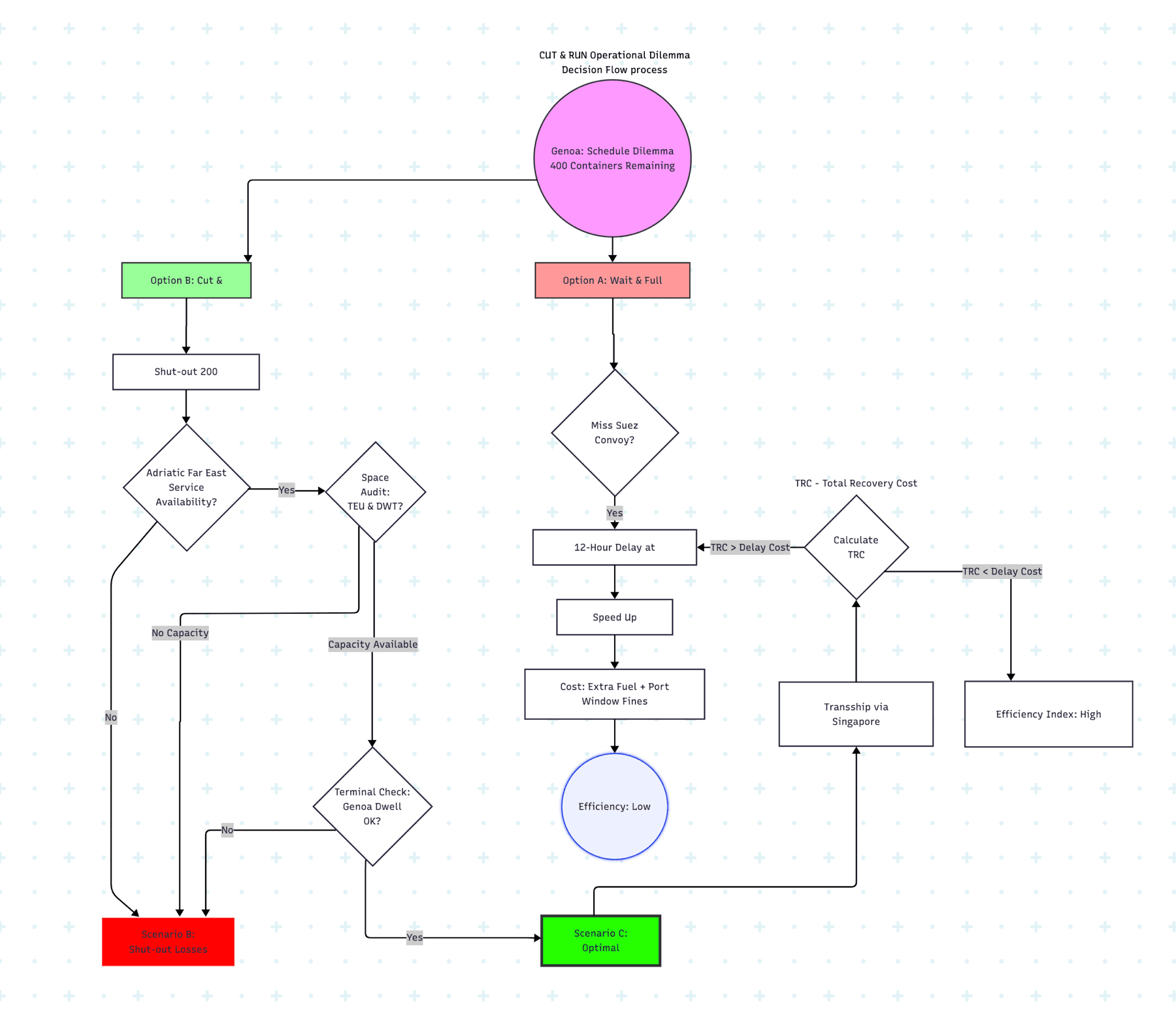
To ground the argument, consider a live operational dilemma. A vessel on an Asia-Europe service calling 12-15 ports is delayed at its final Mediterranean port, Genoa. To join the scheduled eastbound Suez Canal convoy it must depart immediately, but 400 containers remain to be loaded, a process requiring 5 to 6 hours. Missing the convoy means a 12-hour delay at the Suez anchorage.
The Operations Manager faces a Cut and Run decision: leave roughly 200 containers behind to make the convoy, or finish loading and accept the delay. A second service calls at the same Genoa terminal two days later and could recover the left-behind cargo, but that requires transshipment at Singapore, adding handling costs and potential vessel speeding.
The primary conflict is between cargo integrity (loading all planned units) and schedule integrity (holding the Suez convoy window). When a vessel falls behind at a key hub, the delay cascades through the entire rotation.
The decision model
A decision-enabling system compares the Total Recovery Cost of cutting and running against the Delay Impact Cost of waiting. The recovery formula accounts for transshipment charges, fuel for speed adjustments, terminal dwell at Genoa, the time value of the recovery vessel, and commercial risk from delayed cargo.
The counterweight is the cost of waiting: 12 hours of vessel hire at the Suez anchorage, the fuel burned catching up, and late-arrival penalties across the next 10-12 ports in the rotation. The system triggers a Cut and Run only when recovery costs less than delay.
Efficiency Index
EI = DIC / TRC
Questions for the executive agenda
For shipping executives evaluating their organization's decision capability, five diagnostic questions apply:
“The future of container shipping will not be commanded from dashboards alone, but from systems that can think, optimize, and act.”
- Decision inventory: can you name the 5-10 decisions that most impact your profitability, and measure how well you make them?
- Latency measurement: what is the average time between signal detection and optimal response in your organization?
- Alternative evaluation: how many alternative scenarios does your team evaluate before committing to a decision?
- Consistency audit: would two people, given identical information, reach the same conclusion?
- Governance readiness: do you have frameworks to govern AI-assisted decisions at scale?